Tell us about the evolution of Crane Girl? What inspired you to write it and how has the script evolved over the last few years?
Crane Girl first took root in a playwrighting course helmed by Anna Chatterton. Anna asked us each to make a list of things that we were obsessed with to see what might spark a compelling play. The two things at the top of my list? Women who rage under the crushing hand of the patriarchy and a news story about a woman who free-climbed a twelve-story crane in the middle of downtown Toronto. I wrote two scenes and then promptly ignored it for three years. But these two ideas repeatedly bumped up against each other for me, and in 2023 I sat down to write the entire story, and I presented a staged reading of Crane Girl at the One Night Only Festival in Toronto. This year, Crane Girl won the Best New Play Award from a Hamilton Fringe jury, which meant that Crane Girl was gifted a slot at the 2025 Hamilton Fringe, where she made her world premiere climb this past July!
I don’t know that we ever learned why the Toronto woman the play is based on decided to climb the crane. Why did you end up going in the direction you did in terms of the story your fictional character is given?
The fact that there may have been no articulated (or particularly satisfying) reason in the news stories about why this woman climbed that crane makes it such a rich jumping-off point for theatrical creation. While this play is inspired by the news event, it is an entirely fictional exploration of what might cause someone to make a life-changing, and almost inconceivable, climb. My story follows Jane, a married woman who, after witnessing a tragic event, begins to question the societal, political, and patriarchal structures that dominate her life. She can find no way out of the cage that has been built around her until she realizes she should not have been looking for a way out, but rather, up. Jane moves from feeling stuck and numb to tapping into her truest self, including that emotion which women are repeatedly told to tamp down, overcome, or keep in check: rage. When thinking about what might lead Jane to make such a climb, I realized it would be not one moment, but rather a steady simmering of multiple things until the pot itself boils over. And boil over she does.
I gather that the entire play is performed on construction scaffolding? Why did you decide to do that, and did your director self every regret that decision? What was the rehearsal process like (presumably lacking a crane for most of it..)?
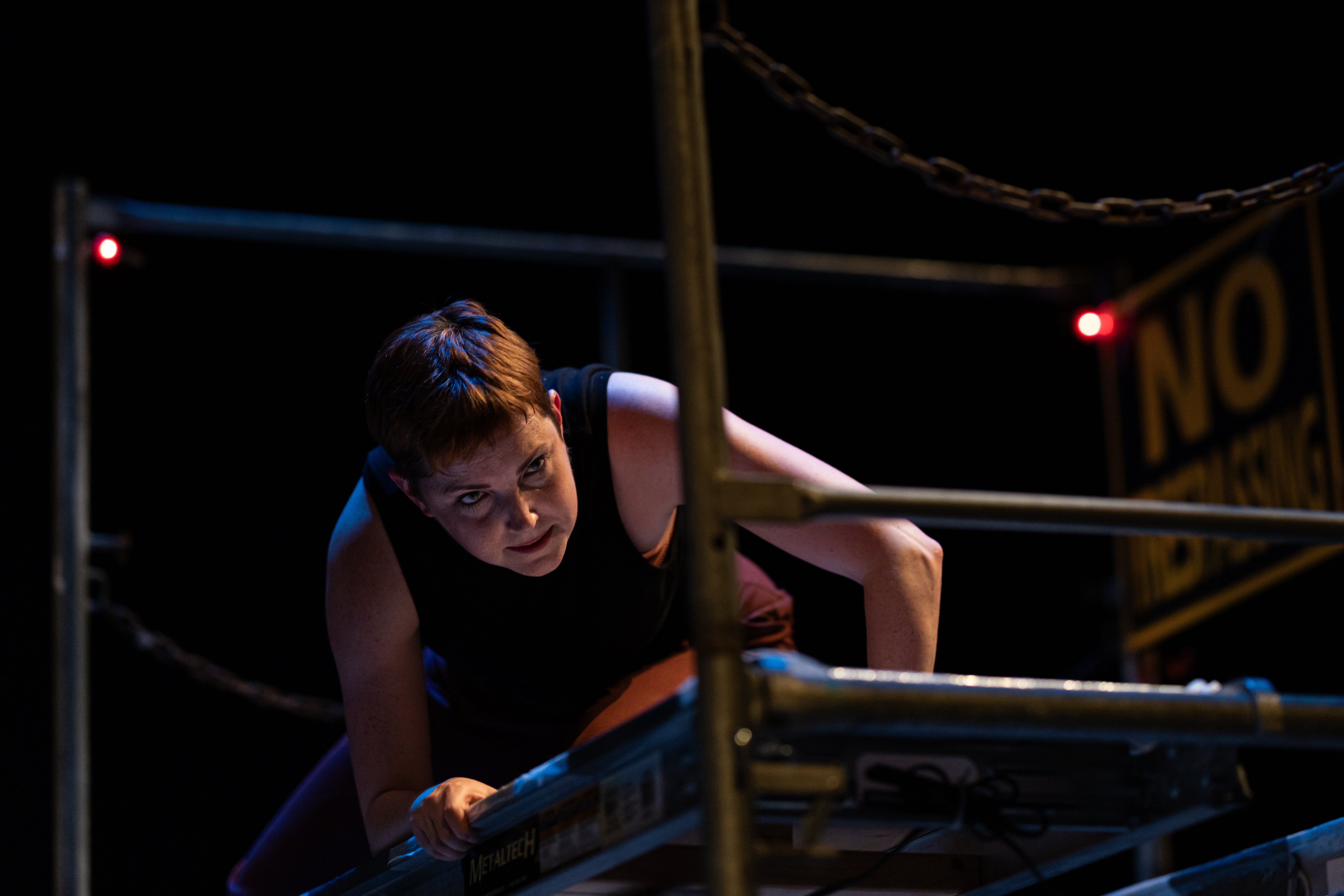
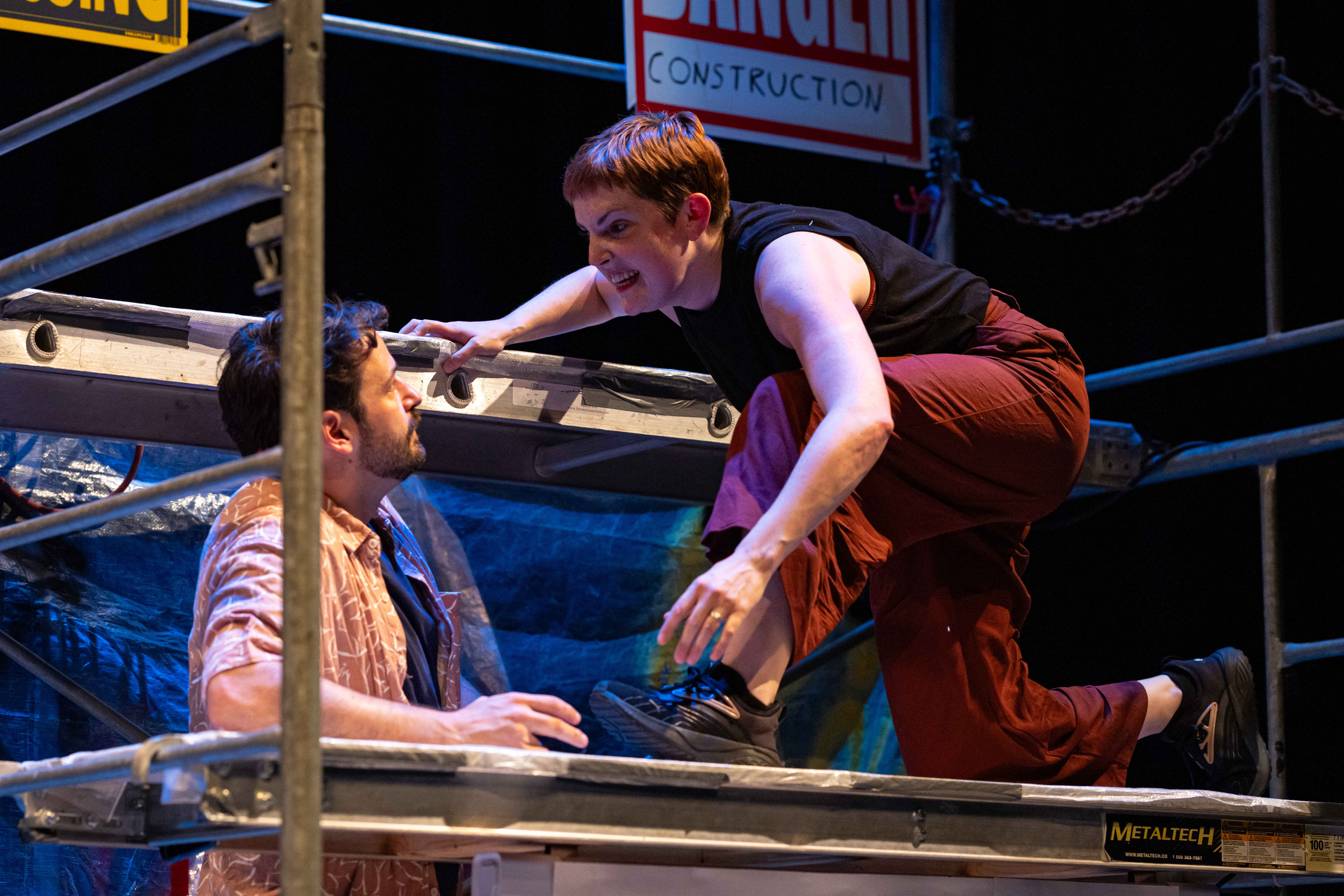
When I was preparing to direct the staged reading back in 2023, I realized that I wanted our title character to be off the ground for the entire show. This play jumps around chronologically, but even when we are in a flashback or a memory, Jane is always connected to the crane. The crane is always a figure in her life, beckoning her, taunting her, witnessing her, and ready for her. Isn’t that a cool idea? I thought so too…until Falling Iguana Theatre (and primarily production designer/hard-working husband Ian Ottis Goff) started building the set design this summer for the full production. Like Jane, we’ve gone on a roller coaster with our temperamental metallic fourth character. Over the rehearsal process, we have come to love this scaffolding and everything it does to (literally) elevate the story. As director, I began rehearsals with chairs and stage blocks (ah, so portable), and we rented bits of scaffolding. We moved through many iterations, rehearsal venues and storage spaces, low ceilings and narrow rooms, until we were finally able to put it all together in the way we had envisioned, and get in some substantial rehearsals and full runs before opening night. As our first stop was a Fringe festival, known for famously fast turnarounds between shows, we also drilled the set up and tear down of the scaffolding over and over again, just in case. There are a few particularly magical moments that occur toward the end of the play that we basically had to wait until opening night to fully explore, but luckily the ensemble moves very well together and (literally) rose to the challenge.
You’re coming to NotaBle Acts after premiering the show at the Hamilton Fringe. How did that go? Will you be revising the show at all for the Fredericton run?
We were blown away with the responses to our run at the Hamilton Fringe! We were thrilled with the amazing feedback and receptive audiences greeting Falling Iguana’s third original production, especially in a city we had never performed in before! We have poured a lot of sweat, bruises, care, and love into this show, and it has been a joy to see that people are connecting to it as much as we do. As a physical theatre production, Crane Girl is tightly choreographed and there are a lot of literal (sorry, they just keep coming to me) moving pieces that combine to give the show a real sense of momentum. That will all be on display in the Fredericton run; however, since we do not need to rush in and out of the theatre for the next show, we look forward to building out the set design even further to immerse audiences even more.
Is there anything in particular you’re looking forward to about performing the play at NotaBle Acts?
Falling Iguana was last at NotaBle Acts in 2021 with our show 81 Minutes (featuring an all-star New Brunswick cast and crew), and we had a fantastic sold-out run! I love this festival, and I love new work and seeing work by a combination of emerging and established writers in New Brunswick. New Brunswick is my company’s, and my own, second home, and I always jump at the opportunity to come home and connect with the vibrant theatre community here. I think, thanks in part to companies like our friends over at Solo Chicken, Fredericton audiences connect with and respond to work that is physical, funny, bizarre, and wholly entertaining. I look forward to sharing this work with NotaBle Acts audiences. I truly think that people will enjoy the climb.
 NotaBle Acts